A fine legacy forged in friendship
From:China DailyAuthor: 2024-04-11 15:46
In 1685, desiring better links with a faraway land to the east, Louis XIV of France dispatched five mathematicians to Beijing to share the latest scientific and astronomical knowledge, and build a bridge of friendship.
The king worried whether his envoys had completed the hazardous sea journey and safely arrived at their destination, and so in 1688, he wrote a letter of greeting to Emperor Kangxi of the Qing Dynasty (1644-1911).
The letter never made it. Well, not until today, for a copy has finally arrived at its scheduled destination, the Forbidden City in the heart of Beijing, which is now known as the Palace Museum.
Though direct correspondence between the two longest-reigning monarchs in the history of their respective countries failed to materialize, had it happened, Louis XIV would have been satisfied.
The mathematicians not only arrived in Beijing after an arduous three-year journey, but were warmly welcomed by Kangxi, starting a beneficial relationship spanning generations that would resonate between the royal palaces of both countries — the Forbidden City and Versailles.
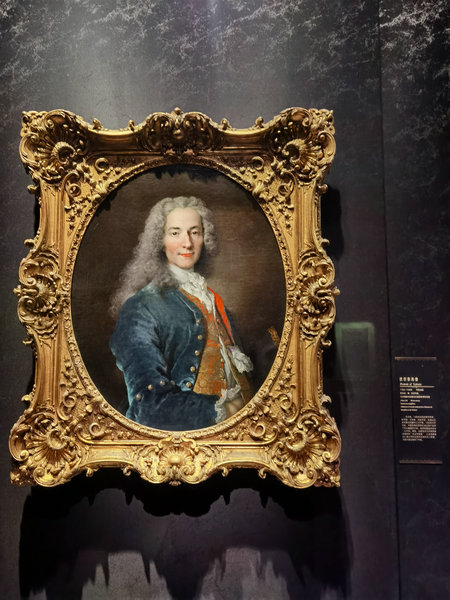
A portrait of Voltaire from the collection of the Palace of Versailles. [Photo by WANG KAIHAO/CHINA DAILY]
The story is currently being recounted at the gallery of the Hall of Literary Brilliance (Wenhua Dian) in the Palace Museum in a widely-anticipated exhibition, The Forbidden City and the Palace of Versailles: Exchanges Between China and France in the 17th and 18th Centuries.
Along with the replica letter, around 200 relics create for visitors a sense of the bonhomie between the two palaces.
"Both are home to many remarkable treasures," Wang Xudong, director of the Palace Museum, said at the opening on April 1. "When the two names appear together, it represents the meeting and dialogue between the civilizations of China and France."
He adds that it was a "golden era of communication", when French royals showed strong interest in China, and French people working in the Chinese royal courts also exerted influence in fields such as the natural sciences, fine arts, architecture, medicine and cartography.
"Through the dragon's encounter with the fleur-de-lis … we can see how the two countries made an effort to develop a mutual understanding, and how during that period, both cultures bloomed," he says.
The Dragon and the fleur-de-lis
Wang's reference to the respective royal emblems of the two countries was not just metaphor. One of the highlights of the exhibition, a gilt copper pocket watch from the collection of the Palace Museum, offers physical evidence of that same poetic view of the relationship.
With a fleur-de-lis in the center of the watch face and Louis XIV's portrait on its case, the movement is covered by a shield decorated with a dragon with five-fingered claws, a motif that belonged exclusively to Chinese emperors. Engraved with the name of a Parisian studio, it is believed to have been a personal gift given from the Sun King to his Chinese counterpart, according to Guo Fuxiang, a researcher at the Palace Museum and chief Chinese curator of the exhibition.
Another key exhibit echoes the significance of the watch. It is a silver ewer with reliefs of auspicious Chinese patterns and motifs, including flowers, birds and pagodas. Produced around 1680 in China, it was presented to Louis XIV by an envoy of Siam (today's Thailand). It survived later social upheavals and is now a part of the collection of the National Museum of the Palaces of Versailles and Trianon.
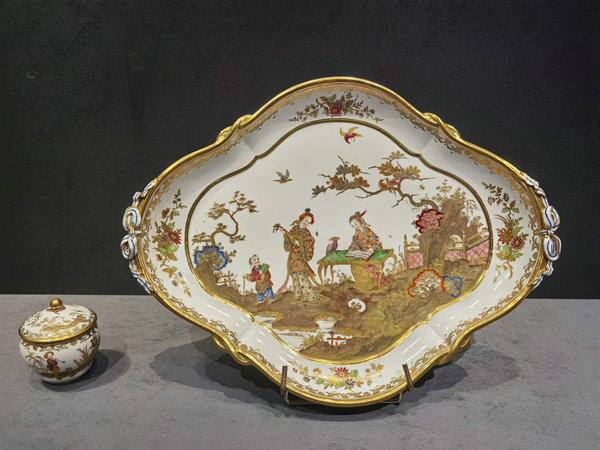
A Sevres porcelain plate decorated with Chinese patterns. [Photo by WANG KAIHAO/CHINA DAILY]
"A clock and a pitcher, the two artifacts demonstrate the mutual respect and admiration the two countries had for each other's cultures," Christophe Leribault, president of the Public Establishment of the Palace, Museum, and National Estate of Versailles, emphasizes. "And the legacy of such exchanges continues."
Guo says that each exhibit was carefully chosen to reflect the interaction between the elites of China and France, a lesser-known chapter in this history. As such, many special items in the inventory of the Palace Museum have an opportunity to be displayed, revealing a less well-known side to royal life in the Forbidden City.
For example, French mathematicians stirred Emperor Kangxi's interest in geometry. A 1690 copy of Euclid'sElements of Geometry— handwritten in the Manchu script used by Qing royals — is the only surviving edition of its kind, and provides a key reference for the studies into the history of mathematics.
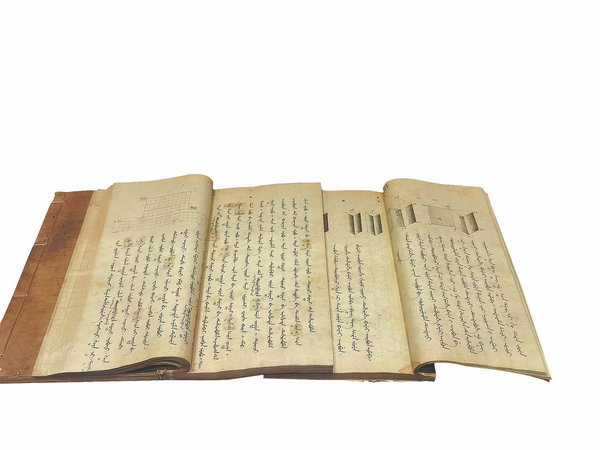
Euclid's Elements of Geometry,handwritten in the Manchu script. [Photo by WANG KAIHAO/CHINA DAILY]
A gilt copper goniometer, a telescope and a case to hold measuring tools together paint the image of Kangxi as an engaged student of science. The emperor categorized imported scientific gadgets as ceremonial royal paraphernalia to attest to their importance.
He even ordered his own royal workshop to produce duplicates, including that of a mechanical calculator based on the model developed by French mathematician, Blaise Pascal.
"The mathematicians accompanied Kangxi on a daily basis, showing his recognition of the scientific knowledge and humanistic literacy of the French teachers," says Marie-Laure de Rochebrune, a researcher at Versailles and chief French curator of the exhibition.
If the idea of Emperor Kangxi as a devoted and enthusiastic student of Western science is not eyebrow-raising enough, a portrait of his son, Emperor Yongzheng, certainly is.
A portrait of the young emperor, best known for his diligence and devotion in handling national affairs, wearing a powdered wig and Western clothing and looking as if he is on his way to attend a ball, is sure to amuse visitors.
"It shows his interest in European fashion," Guo says. "Despite appearances, he was a maverick at heart."
For French royals, there was a passion for Chinese-style decoration, which can be seen at Versailles, he adds.
"France was both the birthplace of the term 'Chinoiserie' and the driving force behind its development," the curator explains. "In 1700, Louis XIV kicked off his celebrations of the new year, and of a new century, with Chinese-themed festivities, and elevated the fervor for Chinese culture to a new level."
Marie Leszczynska, wife of Louis XV and Queen of France, had a particular affinity for China. She had a room with Eastern aesthetics created in the heart of her private apartment, which was known as the Chinese Chamber.
The queen herself even cooperated with the painters at the royal court to create a series of picturesque images based on accounts given by travelers to China, including an oil painting, Market of Nanjing, which is part of the exhibition.
Curators have also created a replica of the chamber in the center of the gallery to honor the queen's special contribution to the spread of Chinese aesthetics in France.
"There was a deep admiration for Chinese culture among the French aristocracy, and this provided inexhaustible nourishment for intellectuals and artists," Guo says.
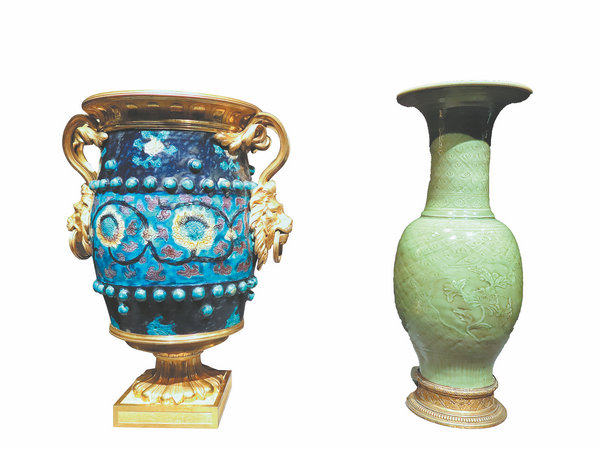
Chinese porcelains mounted with Western-style decorations from the Versailles collection. [Photo by JIANG DONG/CHINA DAILY]
Echoed inspiration
The favorable view of China by French royalty created lucrative business opportunities for Chinese industries, especially porcelain.
When introducing these signature Chinese products to Versailles, French royals wanted something more than dinnerware produced in Jingdezhen, a porcelain production hub in present-day Jiangxi province, stamped with the fleur-de-lis, as some of the exhibits demonstrate.
" (In Europe) there had been an obsession since the time of the Medici dynasty in 16th-century Italy to discover the manufacturing techniques for Chinese porcelain, which was imported at a great cost," Leribault, who is also a veteran art history scholar, explained in a previous interview with AFP.
French artisans finally discovered the mystery of Chinese pottery in the mid-18th century: kaolin. When fired, this variety of white clay whitens even more, giving Chinese porcelain its trademark appearance.
Deposits of the clay were eventually found in France and the examples of exquisite Sevres vases and plates from Versailles, decorated with Chinese patterns, heralded the new era of France being able to produce hard-paste porcelain, just like China.
Equally, when Chinese emperors saw the delicate enamel items coming from France, they wanted their own versions.
French craftsman Jean-Baptiste Simon Gravereau, who worked in the Qing court, specialized in enamel work. When Qing royals ordered customized enamelware from France via the trading port of Guangzhou, Guangdong province, the southern Chinese metropolis evolved into a manufacturing hub for locally produced transparent enamel.
The three baskets from the reign of Emperor Qianlong (1736-95), Kangxi's grandson, provide an interesting juxtaposition between the enamel products produced in the Forbidden City, Guangzhou, and Paris, respectively.
The mix of artistic talent from both countries appears to have created extraordinary products.
When a Jingdezhen green-glazed porcelain bottle arrived at Versailles, it was added to luxury Rococo decorations. Another green-glazed porcelain item produced in Zhejiang province was mounted upon a gilt copper foundation after being acquired by a French aristocrat. The same collector also added an ancient Greek-style gilt bronze base to a Chinese porcelain stool from the Ming Dynasty (1368-1644).
"When the two cultures closely interacted, they inspired imagination and creativity that gave birth to novel elements and styles," Guo says.
New perspectives
As Guo highlights, France not only contributed the most European artisans to the Forbidden City, mostly to make mechanical clocks, but also introduced new artistic philosophies of painting and garden design to the Qing court. The Baroque-style Western Mansions in the imperial resort of the Old Summer Palace may be a perfect example.
Kangxi also entrusted French Jesuit missionaries with nationwide geodetic surveys, and created a complete atlas of his vast territory.
Thanks to these top-level exchanges, new ideas from China also flowed into salons and cafes by the River Seine.
"During the reign of Louis XIV, the idyllic impression of China portrayed by Marco Polo began to gradually be replaced by firsthand information," curator Marie-Laure de Rochebrune says.
She also says that from 1702 to 1776, French Jesuit missionaries traveling to China sent numerous letters to their patrons, which were compiled to provide Europeans with a new perspective and a better understanding of China. Some were included by Jean-Baptiste du Halde in The General History of China, a fundamental text of Sinology at the time. A 1735 edition in the collection of the National Library of China in Beijing is one of the highlights in the gallery. It includes a Chinese atlas, newly drawn as a result of the aforementioned geodetic surveys.
Voltaire, the famous French thinker, became a flag carrier, riding the Sinophile wave. Adapted from a 13th-century Chinese literary classic The Orphan of Zhao — a tragic tale of revenge among nobles set 2,500 years ago — his own play, The Orphan of China premiered in Paris in 1755 and was later widely adapted across Europe.
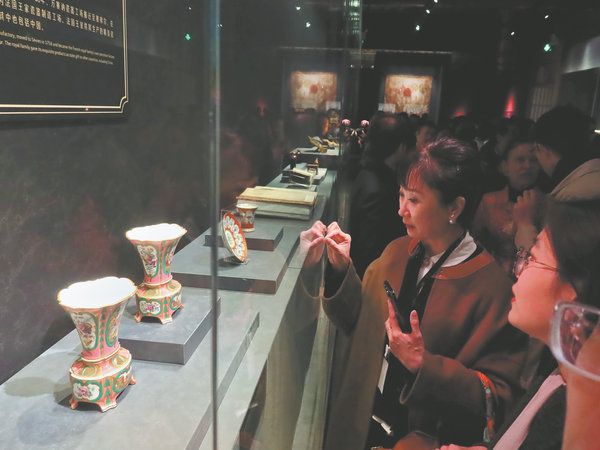
Around 200 relics from both China and France are on display to showcase the exchanges between the Forbidden City and the Palace of Versailles during the 17th and 18th centuries, an era during which porcelain was a key witness to that communication. [Photo by JIANG DONG/CHINA DAILY]
"In Europe, there are scarcely any great houses whose antiquity can be compared to those of the (noble) families of China," Voltaire once wrote.
"It perhaps reflects his utmost respect for China," De Rochebrune says.
Voltaire also admired ancient China's system of governance, in which rulers were surrounded by a group of knowledgeable and reasonable elites. He advocated for the best educated to become civil servants, providing key inspiration for Enlightenment-era Europe.
It is no wonder then, that a portrait of Voltaire, from the collection of the Palace of Versailles, was specifically chosen for the exhibition, where most of the other individual portraits are of royalty.
When French and Chinese state leaders met in Beijing last year, an agreement was reached to mount this long-awaited event. The exhibition, which runs until June 30, is a flagship cultural event that is part of the much-vaunted celebrations surrounding this year's 60th anniversary of the establishment of diplomatic ties between China and France.
The Palace Museum and Versailles also drafted a new plan for future collaboration involving exchanges of exhibitions and personnel, joint research and conservation of relics.
This means that a story that began nearly 350 years ago, in which the history of the Forbidden City and the Palace of Versailles became inextricably intertwined, continues into a new era.
Edit:董麗娜
The copyright of the article and the picture belongs to the original author. If there is any infringement, please contact to delete it